Using linear potentiometers for pseudo-logarithmic volume control
Note: This text assumes knowledge of Ohm’s Law, series and parallel resistances, and voltage dividers
Are you trying to control volume in an audio circuit using a potentiometer? Then you should probably want a “logarithmic-taper” potentiometer, also called an “audio-taper” or “A”-taper potentiometer. Those allow you to logarithmically vary the voltage of a signal going through it as you turn.

By contrast, ordinary “linear taper”, or “B”-taper, potentiometers vary the voltage linearly—the fraction of the turn you set is exactly the fraction of the original voltage you expect. Then, this voltage drives a speaker at a lower or higher power. However, human hearing has been shown to be logarithmic. For something to sound louder and louder with equal steps, we must dump more and more power into the same sound with every next step.
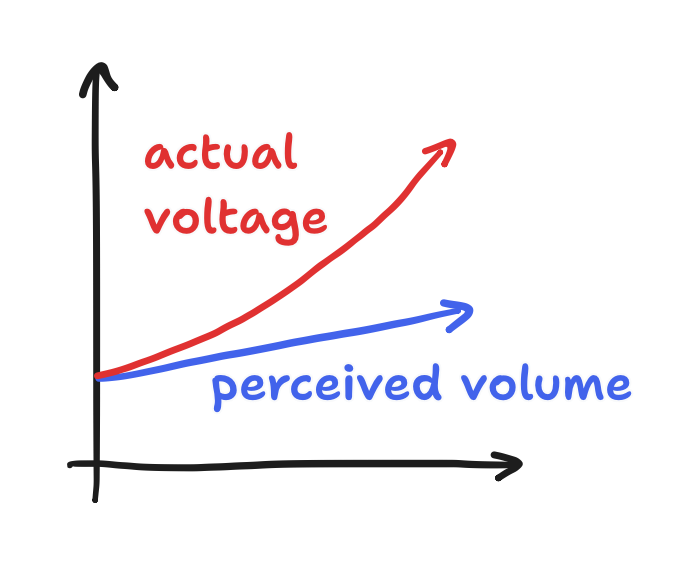
Conversely, we can cut the power by less and less with every step to get something to sound quieter and quieter with equal steps.
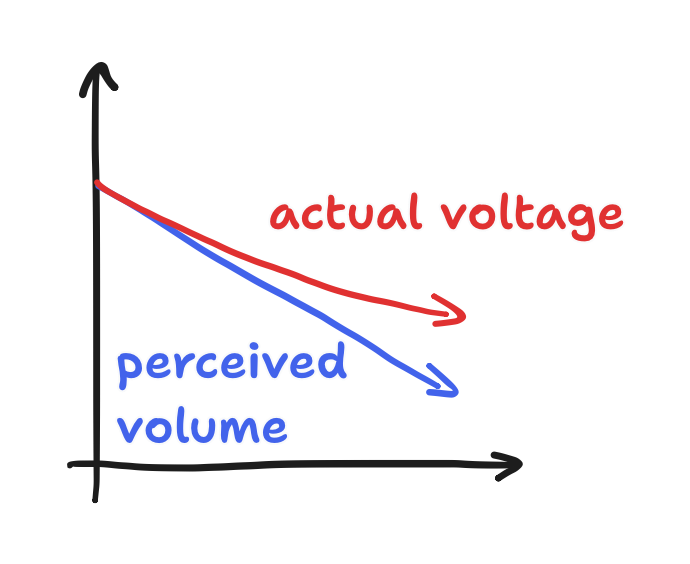
However, linear-taper potentiometers don’t take this human phenomenon into account. As a result, the volume collapses more rapidly as you turn the knob down, and it creeps up more slowly as you turn the knob up. Using a unit called the “decibel”, we can properly plot this behavior on a graph. The “decibel”, formally defined as
\[20 \log_{10} \left( \frac{V}{V_0} \right) \text{dB}\]where $V / V_0$ is the fraction of the original voltage, is that equal step. This number, which can be multiplied with $V_0$ to get $V$, is typically called the “gain”. Since gain is exactly equal to the fraction of the turn for linear potentiometers, we can set this equal to a turn variable $c$ between $0$ and $1$. We can then plot the perceived loudness as $20 \log_{10} c$.
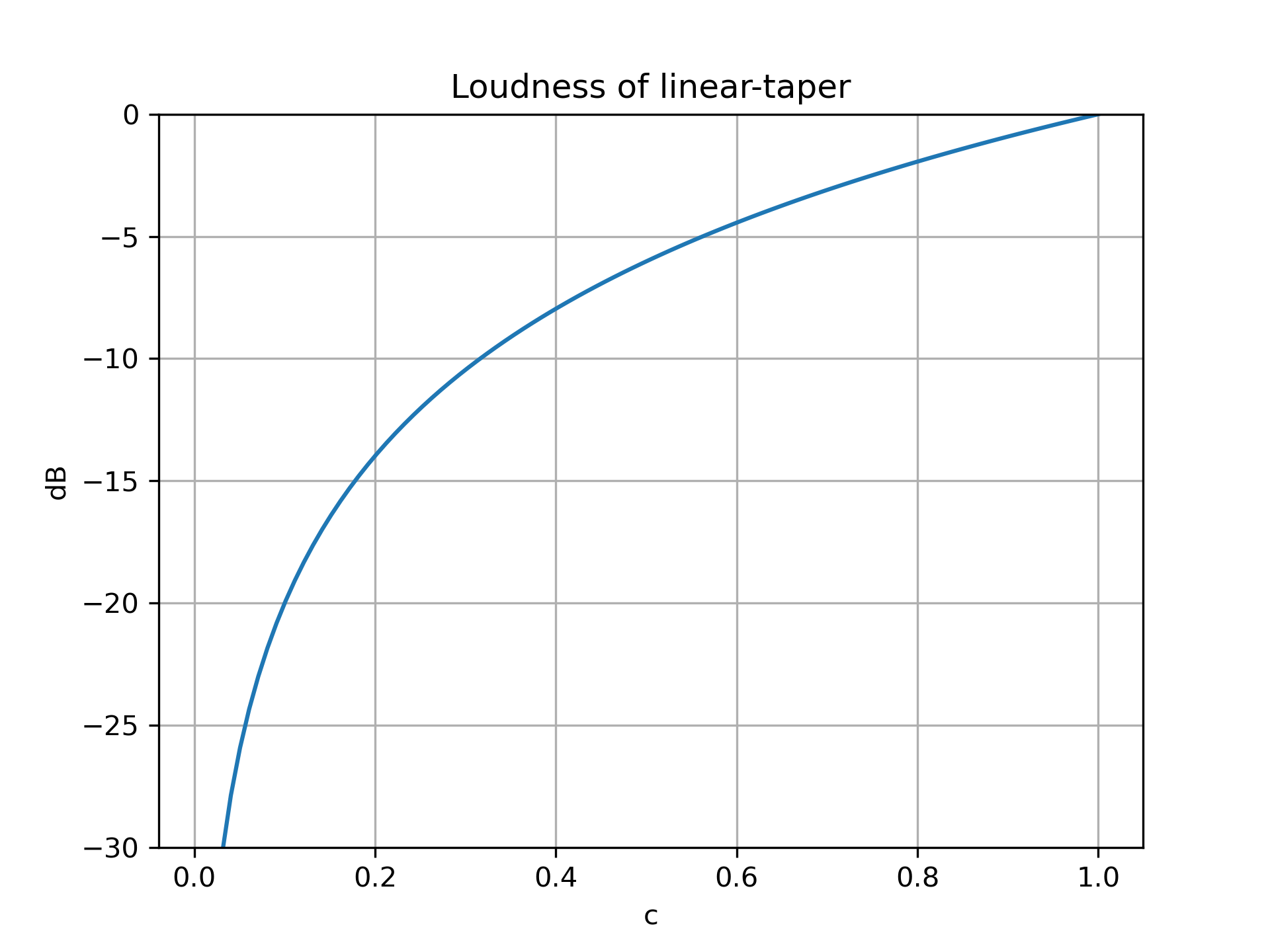
By contrast, logarithmic-taper potentiometers would appear here as a straight line. (In practice, logarithmic-taper potentiometers only approximate the true logarithmic behavior, but they still do a better job than linear-tapers!)
Now, what if we’ve already ordered linear-taper potentiometers but need logarithmic behavior ASAP? You can consider the “loading resistor” technique for a pseudo-logarithmic behavior. This circuit has circulated on the internet long before me, but let’s do a rigorous construction of it to see where and why it works, but also where and why it can fail.
When a potentiometer is used to vary the gain, it is installed as an adjustable voltage divider.
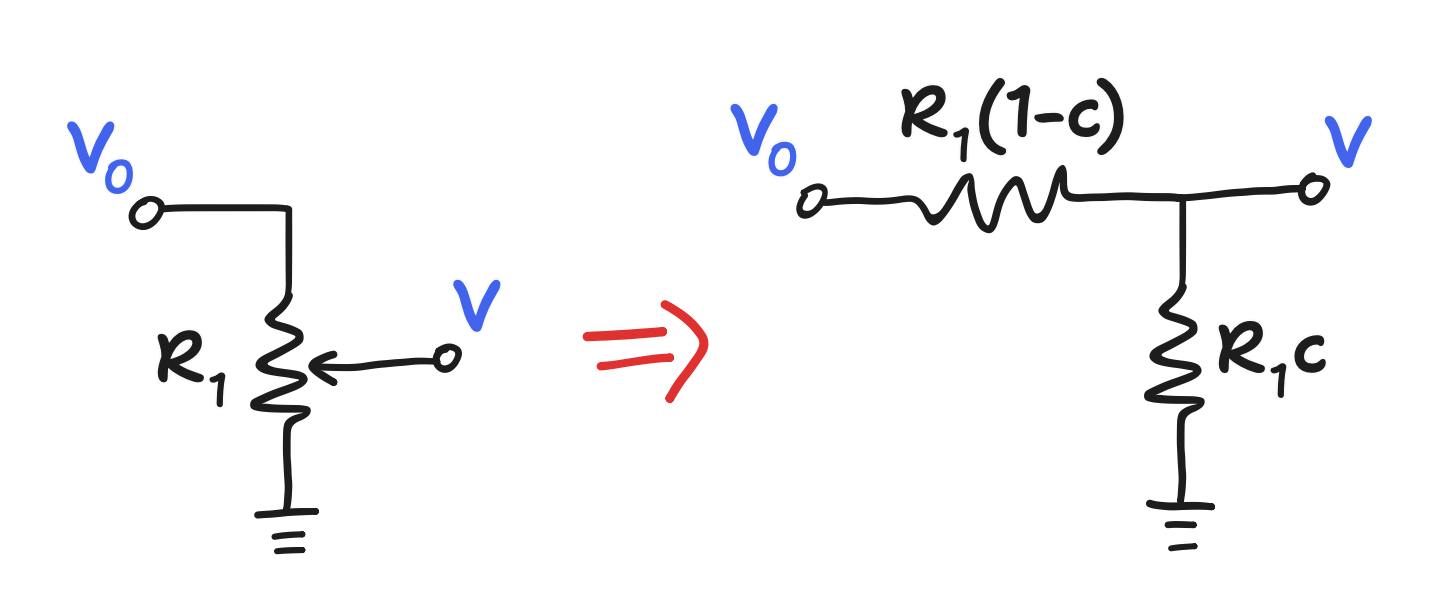
This method works because of the way turning the knob affects the resistances of the upper and lower legs.
\[\begin{align*} \frac{V}{V_0} & = \frac{c R_1}{c R_1 + (1-c) R_1} \\ & = \frac{c R_1}{R_1 + c R_1 - c R_1} \\ & = c \end{align*}\]On the other hand, the circulating design suggests putting a resistor in parallel with the lower leg
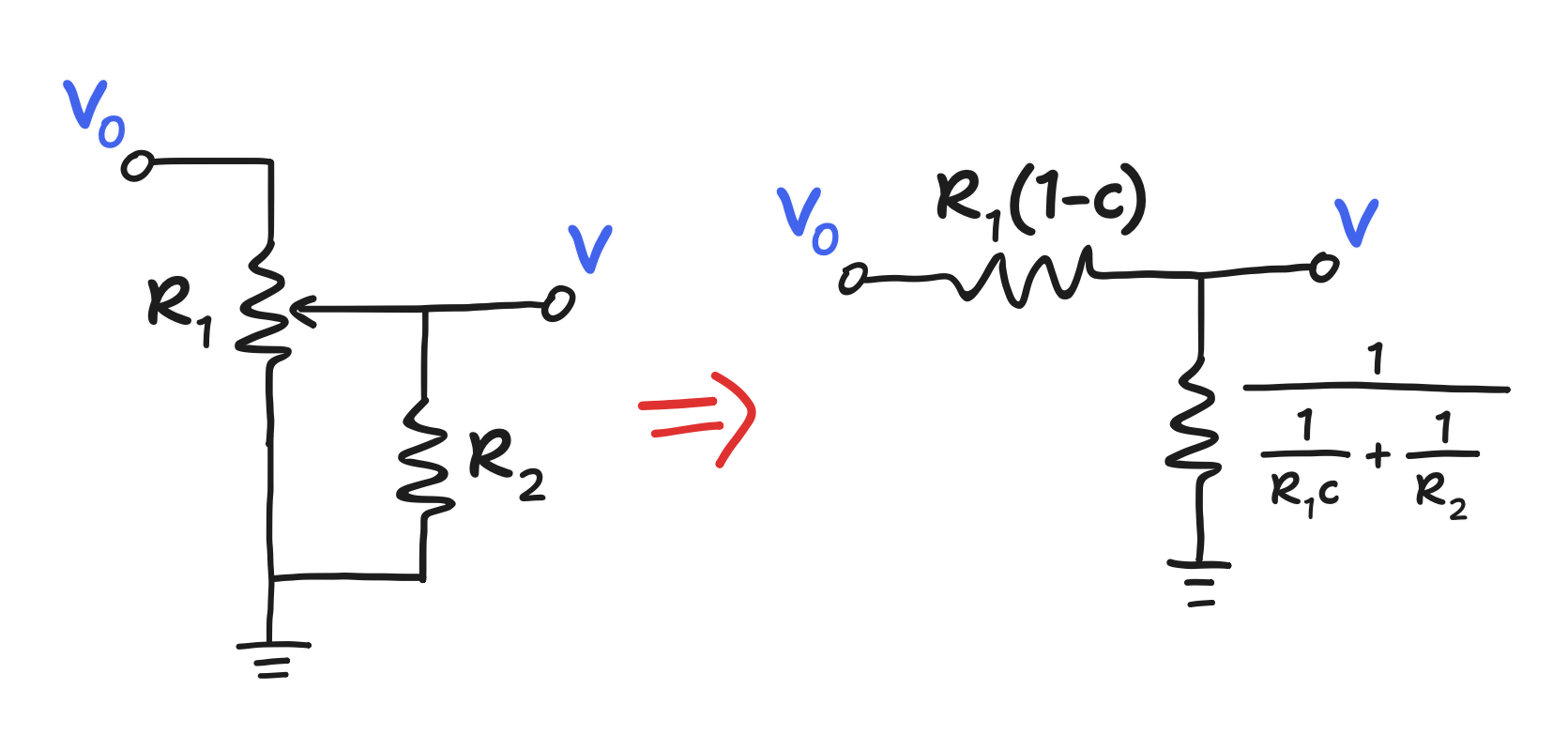
and this gets us a new divider.
\[\begin{align*} \frac{V}{V_0} & = \frac{\frac{1}{\frac{1}{c R_1} + \frac{1}{R_2}}}{\frac{1}{\frac{1}{c R_1} + \frac{1}{R_2}} + (1-c) R_1} \end{align*}\]This is an intimidating expression! However, sources on the loading resistor design typically mention the ratio between $R_1$ and $R_2$ as the thing to tune. If we let this ratio be the variable $r = R_2/R_1$, the expression can be dramatically simplified.
\[\begin{align*} \frac{V}{V_0} & = \frac{\frac{1}{\frac{1}{c R_1} + \frac{1}{R_2}}}{\frac{1}{\frac{1}{c R_1} + \frac{1}{R_2}} + (1-c) R_1} \\ & \, \, \left\downarrow \frac{1}{\frac{1}{c R_1} + \frac{1}{R_2}} = \frac{c R_1 R_2}{c R_1 + R_2} \right. \\ & = \frac{c R_1 R_2}{c R_1 R_2 + (1-c) R_1 (c R_1 + R_2)} \\ & = \frac{c R_2 / R_1}{c R_2 / R_1 + (1-c)(c + R_2 / R_1)} \\ & \, \downarrow r = R_2 / R_1 \\ & = \frac{c r}{c r + (1-c)(c + r)} \\ & = \frac{cr}{rc + c + r - c^2 -rc} \boxed{ = \frac{cr}{r + c - c^2} } \end{align*}\]This reduction shows that the gain of the loading resistor design as you turn the knob—thereby varying $c$—depends only on the ratio $r$. There seem to be many good ratios, but we can take just $r=0.12$ for example. This can be implemented with the potentiometer $R_1$ valued at $100 \text{k}\Omega$ and a loading resistor $R_2$ at $12 \text{k}\Omega$. The behavior in decibels would be
\[20 \log_{10} \left( \frac{0.12 c}{0.12 + c - c^2} \right) \text{dB}\]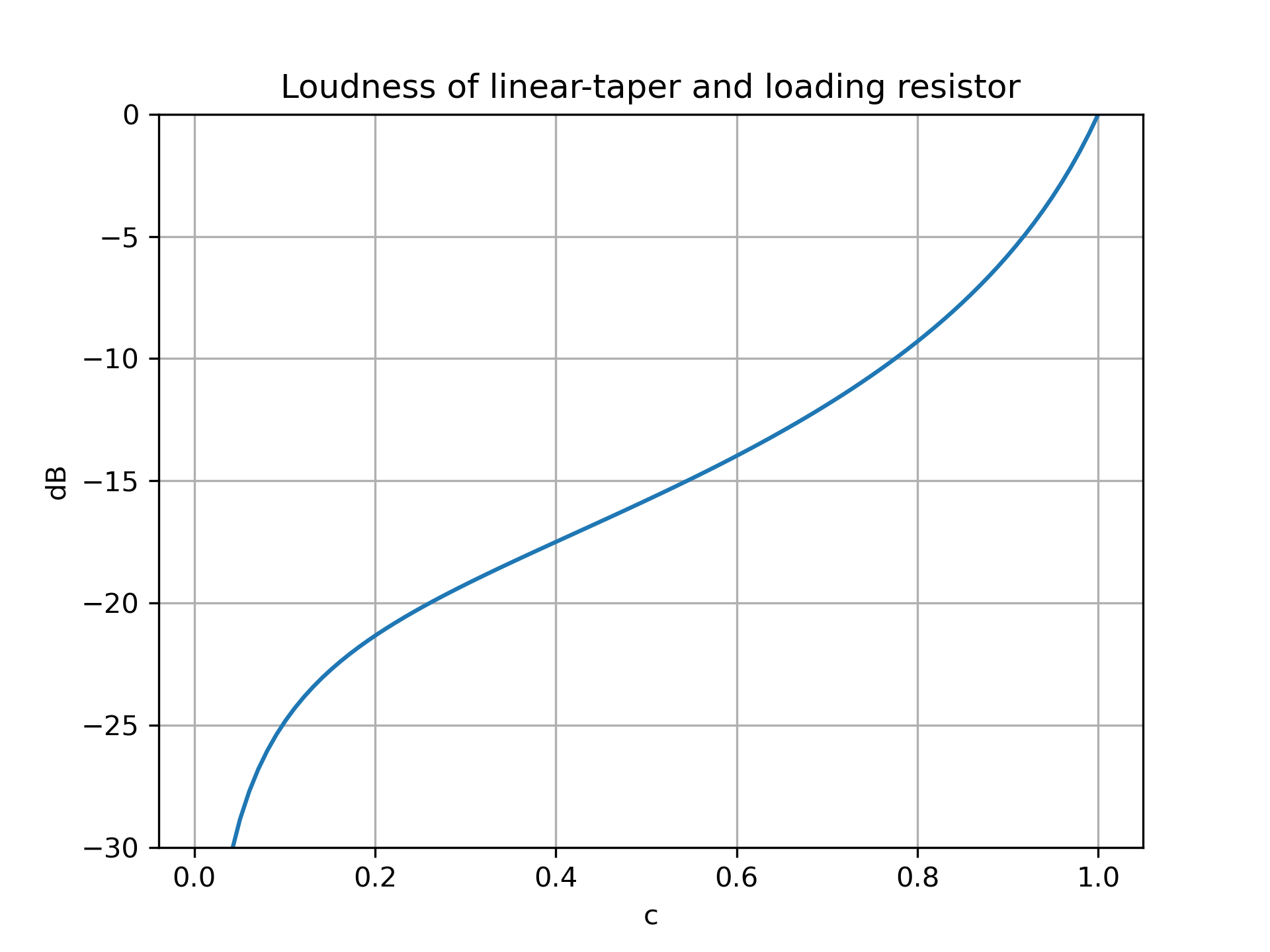
Now, this looks closer to linear! That was a neat result, but the loading resistor method needs to be considered in the bigger picture.
Review: Output impedances and input impedances
You may or may not already know about output impedances and input impedances, so I’ll still cover it here. My understanding of this comes from this excerpt of a Wikipedia article however, so feel free to look there or at other sources as well.
Putting aside all the complexity that goes into designing a good audio amplifier, they’re usually modeled as an “ideal voltage source” chained to an “output impedance”, and if it wasn’t for this output impedance the ideal voltage source could output its set voltage at an infinite amount of current. Instead, as the current drawn increases, the output impedance drops more and more of the set voltage.
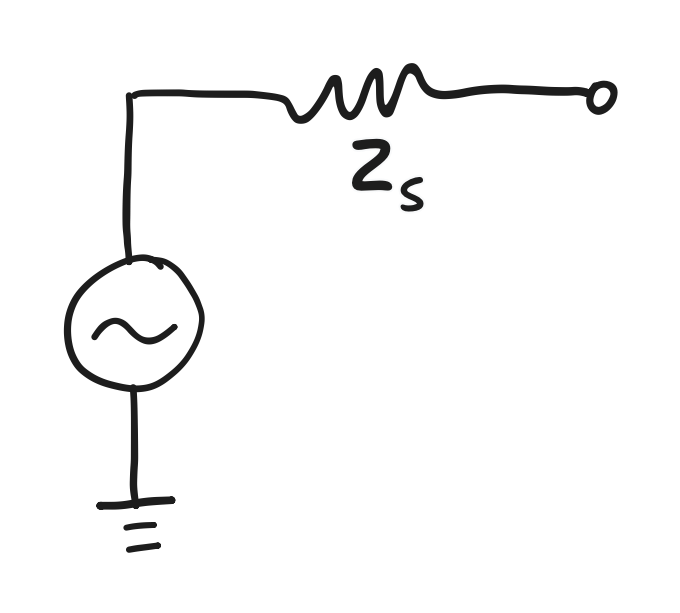
When an amplifier’s spec contains the output impedance, that’s the model invoked. It may be reported as the symbol $Z_s$, and so that will be the symbol used here.
Speakers, headphones, and even the input of an amplifier are usually modeled as a single “input impedance” to represent the fact that they draw current—some more eagerly than others.
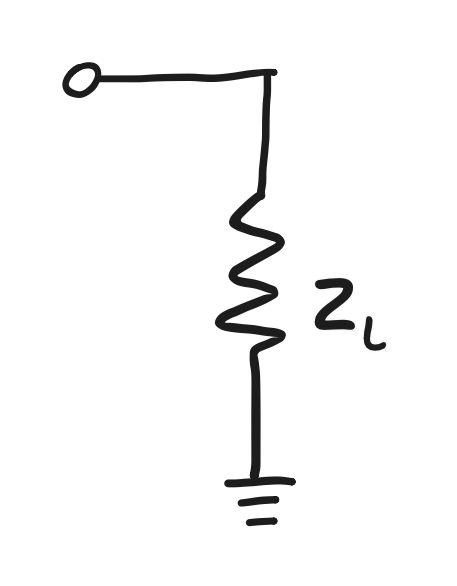
Again, when the specs of these devices include an input impedance, that’s the model invoked. It may be reported as the symbol $Z_L$, and so that will be the symbol used here.
In many diagrams, the bigger picture is not shown, and this usually has no consequence. However, because we’re now holding resistances to specific values, we cannot ignore it: the input and output impedances interfere!
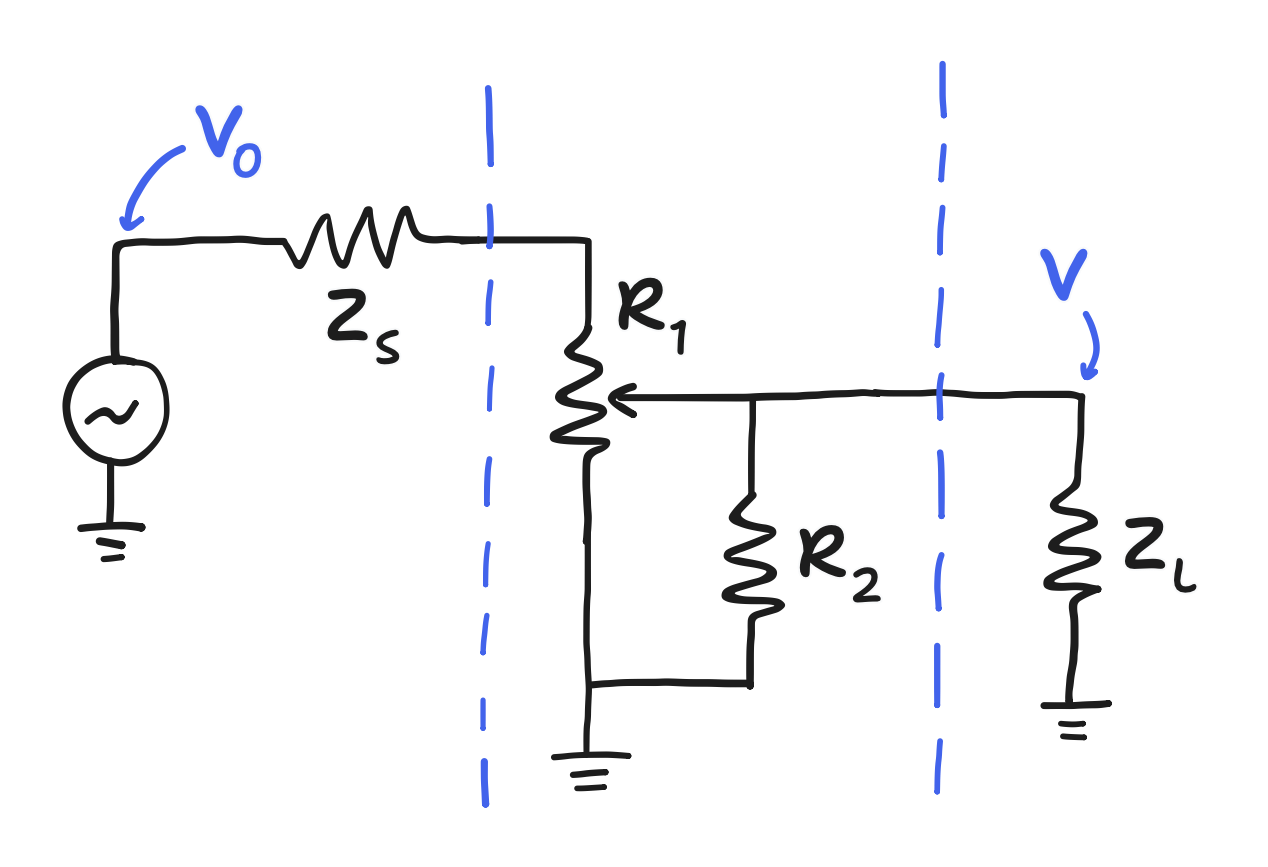
In this scenario, it would technically be possible to calculate exactly what the behavior would be, given the output and input impedances too, then tune $R_1$ and $R_2$ accordingly, but we shouldn’t want to do that. Instead, we can try to claim that the behavior in this bigger picture is a good approximation of the one we originally targeted. To do so, we have to look at the conditions for “neglecting” the input impedance $Z_L$ and the output impedance $Z_S$.
Looking at $Z_S$, we find it in series with the upper leg of the potentiometer $(1-c) R_1$. The condition for “neglecting” that fact is that $Z_S$ is “much smaller than” $(1-c) R_1$. In other words, $Z_S \ll (1-c) R_1$. There’s no solid definition for “much smaller than”, but we can say for now that “much smaller than” means smaller by an order of magnitude, or $Z_S < 10^{-1} \cdot (1-c) R_1$.
Now, $(1-c) R_1$ can actually get arbitrarily small with the right $c$. What we can do about it is give up on getting the approximation right for, say, $c > 0.9$ or the last tenth of the turn in other words. In that case, the condition for neglecting $Z_S$ is now
\[Z_S < 10^{-2} \cdot R_1\]Going back to the example where $R_1 = 100 \text{k}\Omega$, that means $Z_S < 1 \text{k}\Omega$. If we refer to a Wikipedia excerpt about line-level impedances, we find that line-level output impedances vary from $100 \Omega$ to $600 \Omega$. That means we can neglect $Z_S$ as long as we use a line-level output.
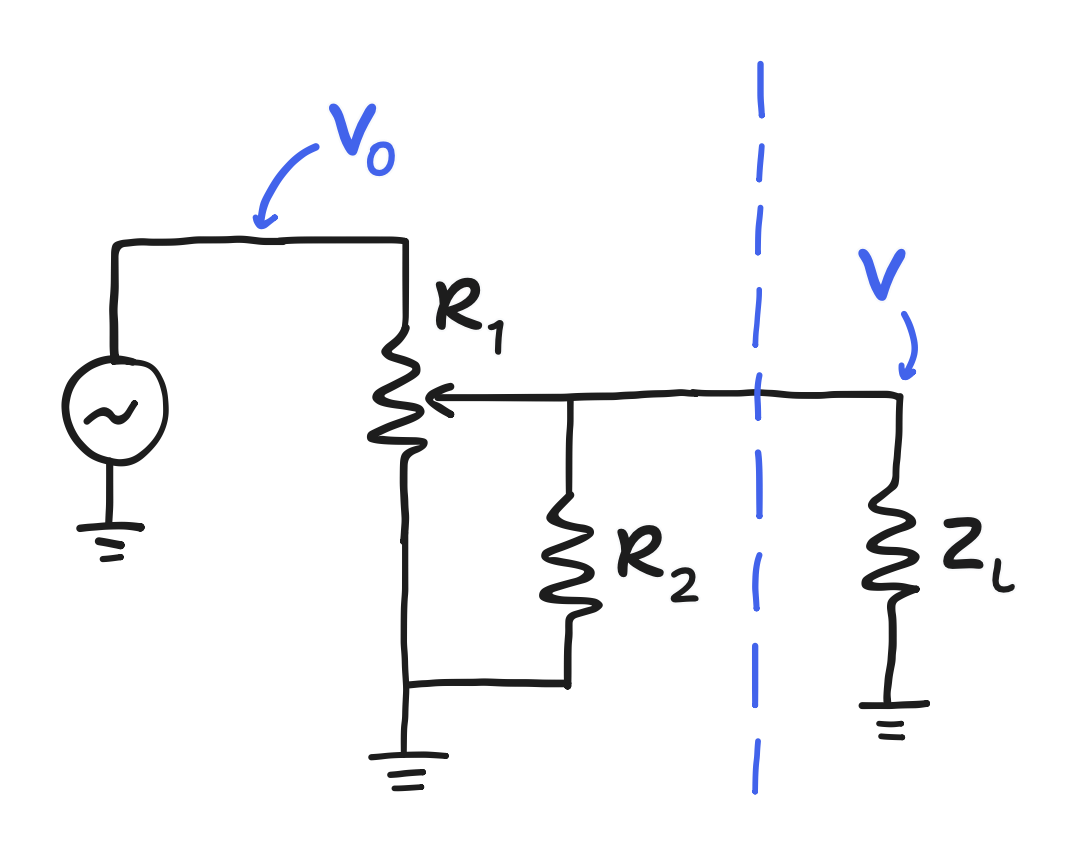
Looking at $Z_L$, we find it parallel with the loading resistor (the lower leg of the potentiometer isn’t part of the problem). The condition for neglecting that fact is that $Z_L$ is “much larger than” $R_2$. Going by “much larger than” meaning larger by an order of magnitude for now, that means
\[Z_L > 10^{1} \cdot R_2\]Going back to the example where $R_2 = 12 \text{k}\Omega$, that means $Z_L > 120 \text{k}\Omega$. According to the same Wikipedia article, line-level input impedances go from $10 \text{k} \Omega$ and up. So, therefore, we have a problem.
The only universal solution here is to place a unity-gain buffer, but I feel that is outside the scope of this article. Instead, we can talk about what we can do to $R_2$ if we focus on some specific $Z_L$.
If $Z_L$ is on the low end of that “$10 \text{k}\Omega$ and up” range, then we can consider ditching the loading resistor altogether. As a result, $Z_L$ itself is our loading resistor! I saw this approach once in a real inline volume control, and it literally was just a linear-taper $1 \text{k}\Omega$ potentiometer used as a voltage divider. If you used a pair of headphones with an input impedance of $120 \Omega$, then you’d still get a ratio of $r = 0.12$! I suspect that there is some analysis to be done here about damping, but I’m not qualified enough to think about it.
If $Z_L$ is past that low end but not large enough to be neglected, then another possibility is to choose $R_2$ such that $\frac{1}{1/R_2 + 1/Z_L}$ is equal to the $R_2$ you originally wanted.
If $Z_L$ is large enough that it can be neglected after all, then we can plot what the behavior actually looks like in the bigger picture and see that it’s very similar to what we originally targeted!
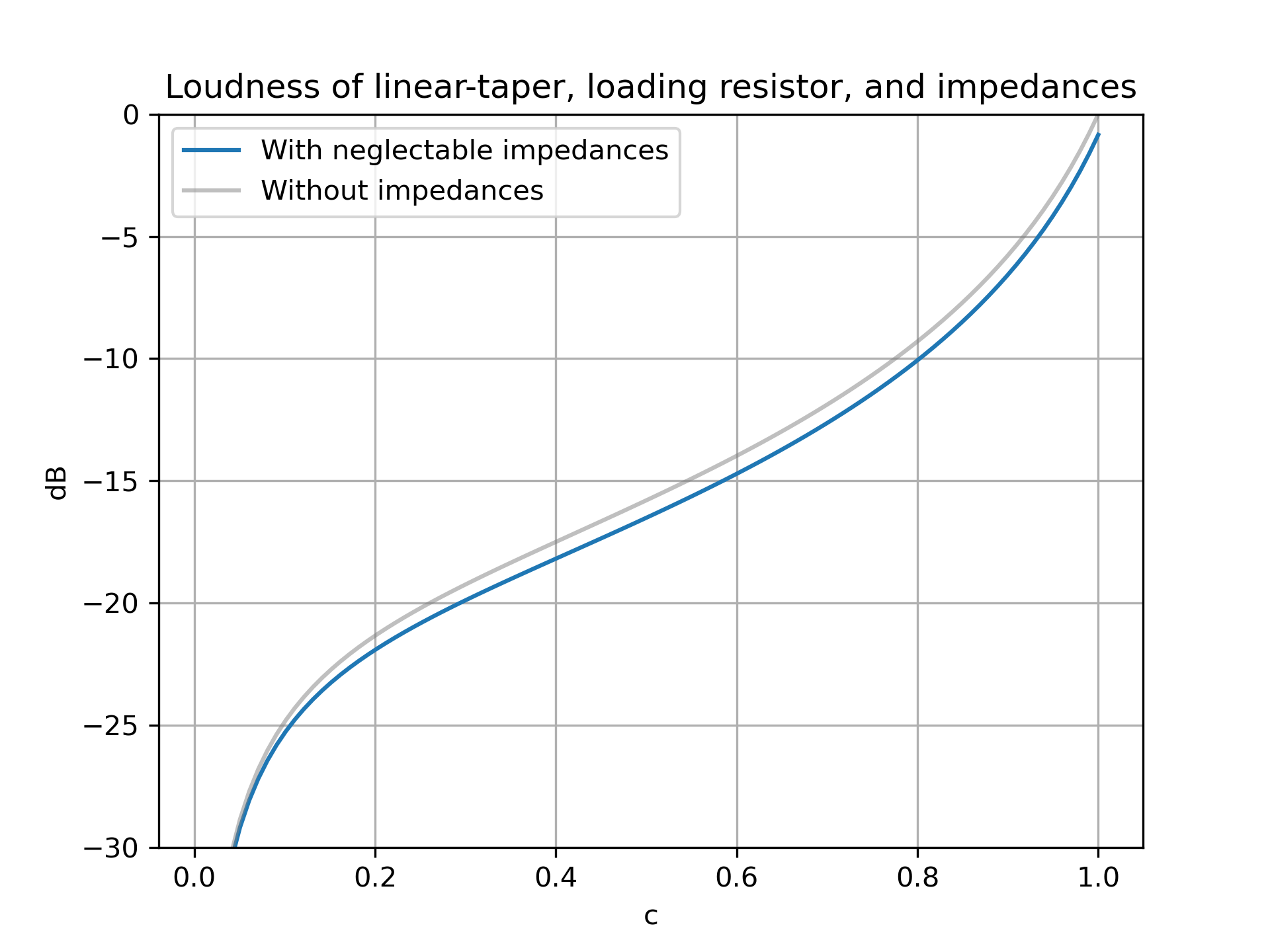
Curiously, we accepted the possibility of significant error for $c > 0.9$, but this doesn’t materialize. I suspect that there might be an explanation for this revolving around $R_2$. Regardless, at the very least I’m sure that the condition for neglecting $Z_S$ presented will always be sufficient, though it doesn’t appear to be necessary here.
Addendum: “Second-order” Pseudo-logarithmic Volume Control
Notice that the range of volume control for that circuit was 20dB, give or take. There is a class of pseudo-logarithmic volume control circuits that are what I’d call “second-order” in nature, with a range of around 40dB, though they require an op-amp. Here is the simplest version I’ve found.
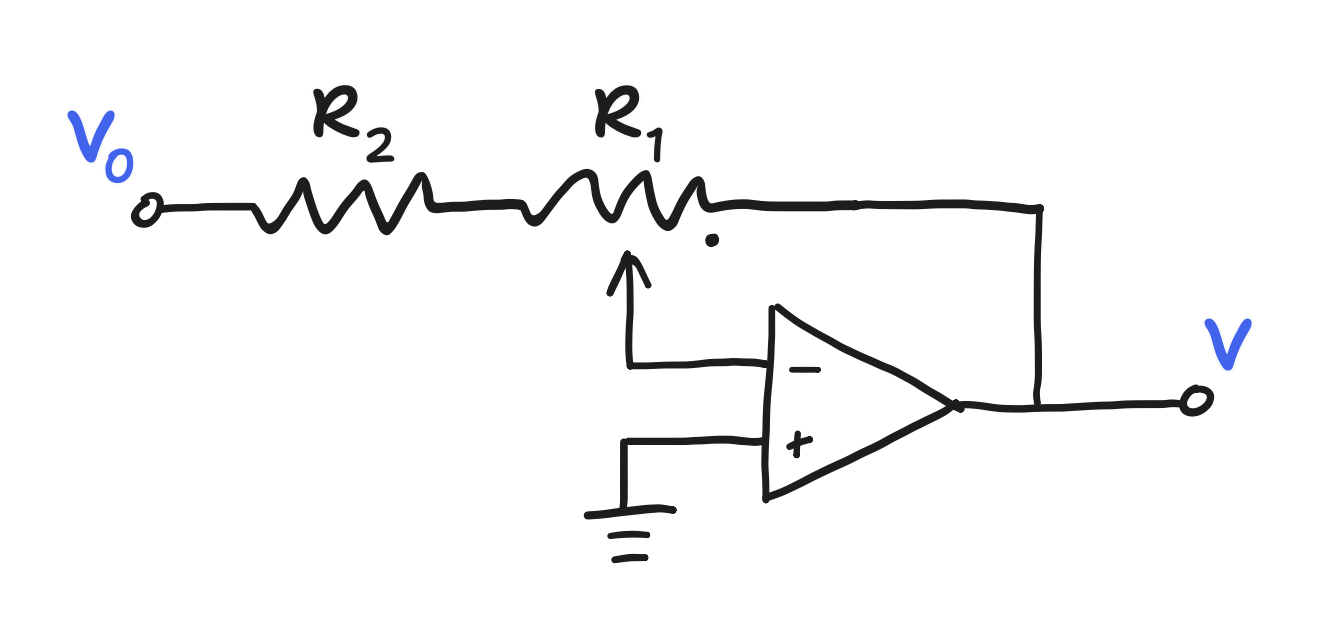
It has a gain of
\[\frac{V}{V_0} = \frac{-c}{r-c+1}\]with the decibel plot
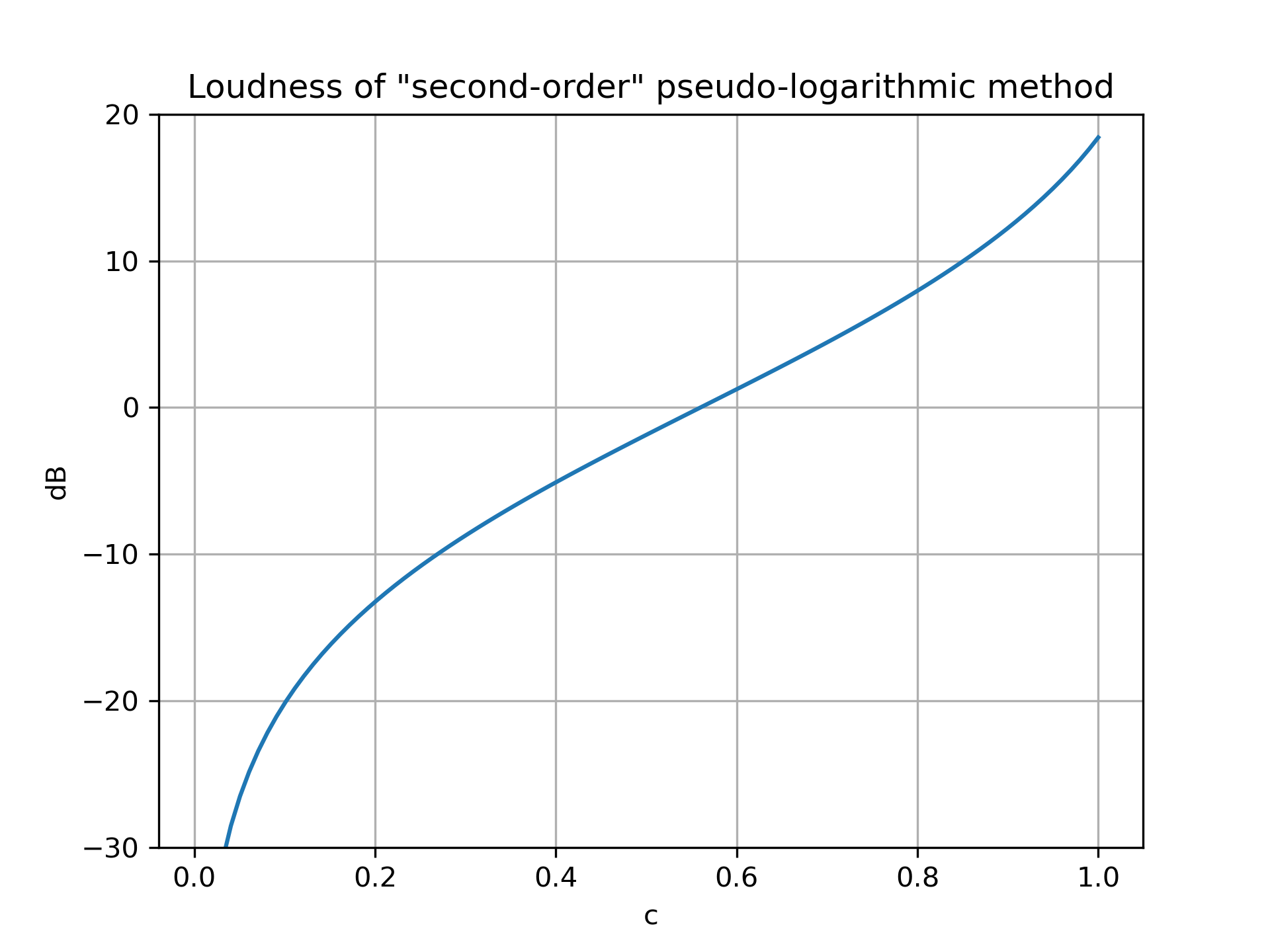
As an op-amp is involved, the direction also happens to introduce some amplification, which may or may not be also helpful, and the turn of the potentiometer is roughly split evenly between attenuation and amplification. As can be found from the above expression–now not just a fraction but a number that can be greater than one–the maximum gain is just $r^{-1}$, or $R_1 / R_2$. In this case, that’s about 8.333, or 18.5 dB.
Though, I wouldn’t recommend using this specific example in the real world. If the potentiometer fails, it could break the negative feedback loop, and the op-amp would next go slamming into its rails. A circuit that does that isn’t acceptable because it could harm anything that plugs into its output. At the very least, there would have to be a clipping circuit, like this.
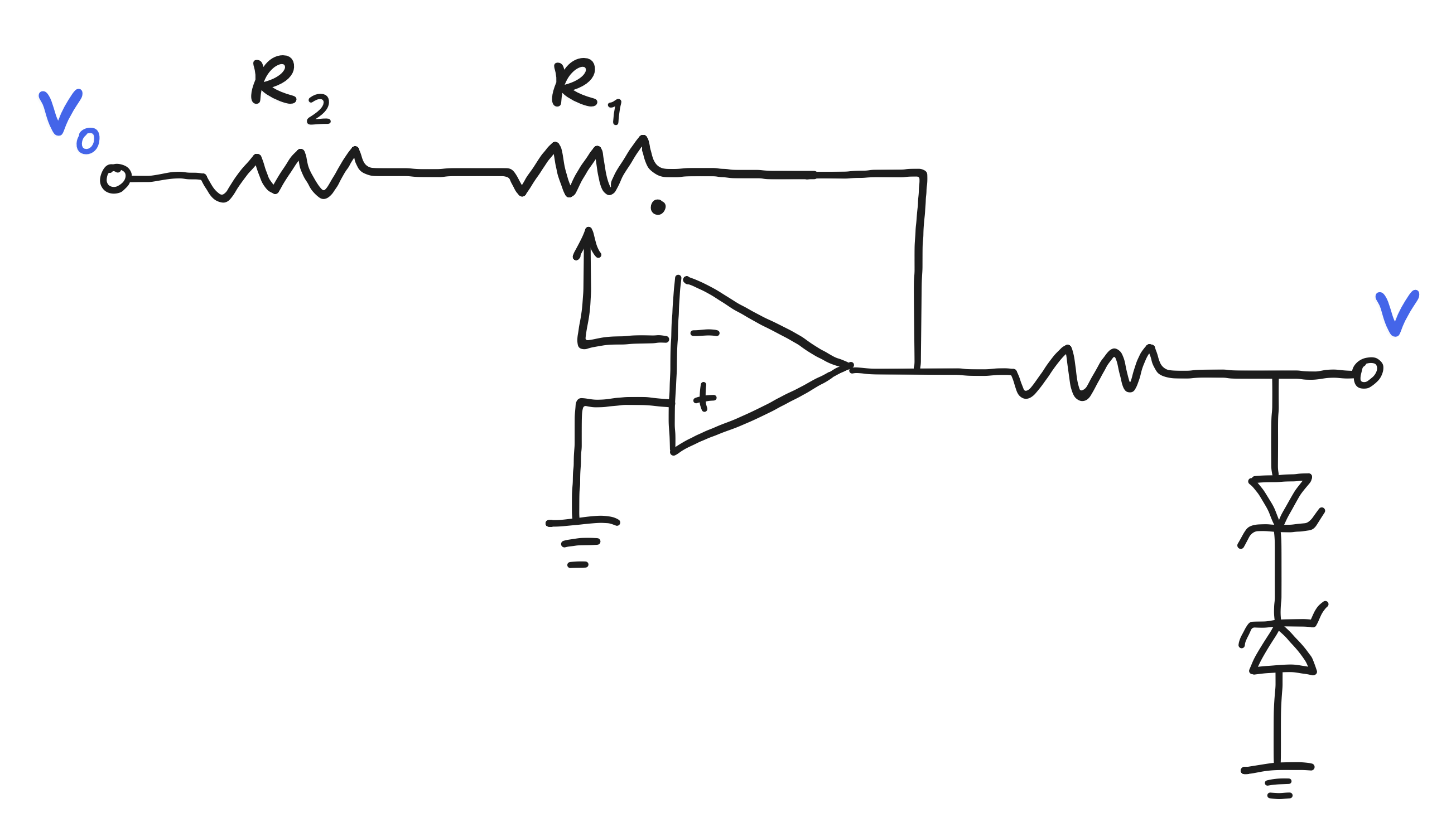
The Zener diodes are in “anti-series”, i.e. they’re connected end-to-end but with like polarities facing each other. It’s cathode-to-cathode, not cathode-to-anode. The effect is that the voltage, whether positive or negative, must be greater than the forward voltage 0.7V of one diode plus the Zener breakdown voltage of the other before the pair starts to conduct. Any excess voltage–in either direction–is shorted. Now, shorting the op-amp would be no good either, so necessarily there is a resistor between the Zeners and the op-amp output, its value depending on how much short-circuit current is tolerated. But the output also needs to be on the other side of that resistor. We’re faced with a trade-off between output impedance and short-circuit current, not to mention all the complaints people may have about putting a non-linear device in the signal path. And sure, many op-amps can survive being shorted outright, and that resistor can go up to 1k Ohm before the output really stops being a “line output” (neglectable output impedance, relative to a standard 10k “line” input impedance), but none of this feels ideal.
It would almost seem like “second-order” circuits are only good in theory, but in fact, at least one real good one seems to exist: the Baxandall volume control circuit.
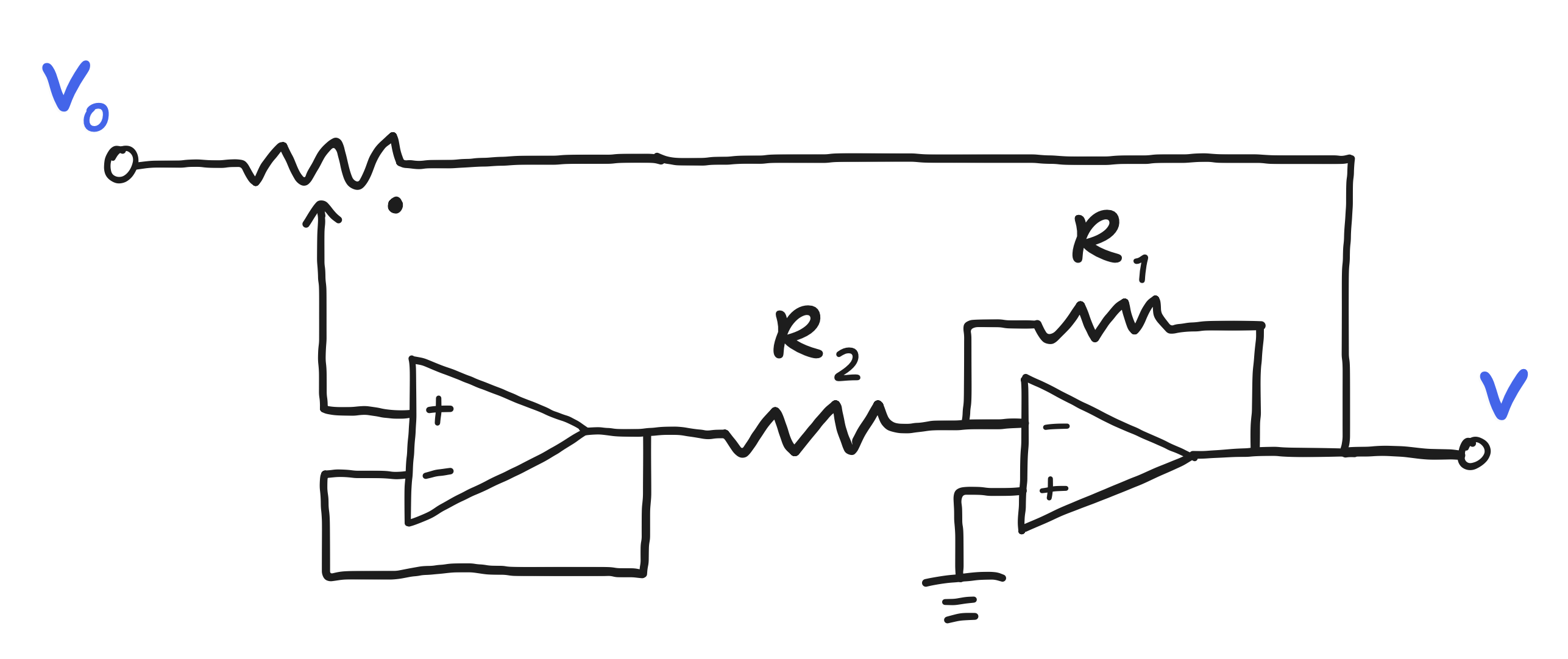
Regarding that circuit, I haven’t tried to get the expression for its gain yet, but I did look into how it would handle the potentiometer breaking. In that analysis, I did find that its maximum gain was also $R_1 / R_2$, but the resistors that were $R_1$ and $R_2$ was surprising. In fact, neither one is the potentiometer, and the value of the potentiometer itself has no impact on the gain.
For more to say, here’s what I wrote in an email to someone asking me about an older version of this section.
I would start by looking into the Baxandall volume control circuit. To be honest, that was largely the circuit I had in mind when I first wrote that there were “safer” second-order varieties out there. But I wasn’t sure about that claim, so I hedged by not mentioning it outright. Sorry about that, and I think I’ll have update that page sometime.
I took a crack at analyzing it for myself a bit. It’s a circuit that also achieves the 40dB of volume control which I’d call “second-order”, but it actually does so without the linear potentiometer inside the negative feedback loop. As a result, it doesn’t pose the same risk of slamming into the rails when the potentiometer is broken.
A caveat to it though is its input impedance. Setting aside the loading of the buffer stage inside for now, the input impedance is the potentiometer resistance divided by the maximum gain minus one, and 40 dB of logarithmic volume control is only achieved when the max set gain is 10 (+20dB). Lower causes less volume control, and higher causes the logarithmic behavior to degrade. Putting in a 10k potentiometer, and the minimum input impedance would only be 1.1k. Putting in a 100k potentiometer, it’d be 11k, but then there’s the loading of the buffer stage to worry about–overall the design considerations for 100k aren’t forgiving. It’s simpler to just put a buffer in front in order to get back line-level impedance.
Also, “Baxandall volume control” should get a couple hits on the internet, but there’s also a section on it in Douglas Self’s Small Signal Audio Design.
Ah, I would add that, in the worst case, it would jump to 10x gain. That’s not as bad as slamming into the rails, but it could require some care.
To correct myself there a bit, though, it’s not that the potentiometer is entirely outside the negative feedback loop, or else it wouldn’t have an impact at all! Rather, the negative feedback loop doesn’t pass solely through the potentiometer. This can help to mitigate the damage that a break in one would cause. Also, “40 dB of logarithmic volume control” is a bit of a soft standard that depends on what one is willing to consider “logarithmic”, so there is a bit of flexibility between choosing +18.5 dB or +20 dB.
One thing I still insist on now is finding a practical design of the Baxandall volume control circuit. That was also true of the other circuit, but this one doesn’t involve clipping Zeners! The challenges with this one just lies in loading, like the loading we covered here in this post.
Finally, I would show my work into the analysis on if the potentiometer broke, but I think that is actually deserving of another blog post. That also gives me the opportunity to actually build out the circuit and probe it. After I get around to it, you can click to the post here.